
And...
By Tori Walters
Of all the decisions made during the college experience, the area of study on which to focus is often the most significant. When multiple academic interests arise, there is no “either/or” with Austin College students, only “and.” The focus on not being too focused often leads Austin College graduates down unique career paths that draw on their unique intersection of interests. For others, it leads to avocational or recreational pursuits that may be pretty different from their day jobs.
Chris Struble '12
The “and” may not get more different than Director of Technology and Burning Man Artist Chris Struble ’12. When graduation approached for Struble, who double-majored in computer science and art, Professor of Art Mark Monroe ’81 gave him one final assignment: to attend the Burning Man festival that August.
“[Burning Man] was quite instrumental to changing my mind at that point in time about what was possible,” Struble said of his first Burning Man. “I had no experience of adults that were just kids. That adults were people you could collaborate or work on ideas with.” Just as Monroe suspected
it would, Burning Man proved to be a creative outlet that Chris needed to balance his work in technology.
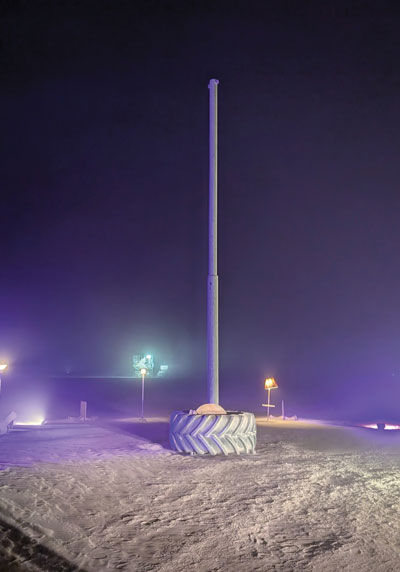
Now the Director of Technology at Imperial Dade, an industrial packaging company, he’s become a regular Burning Man attendee and artist. This year made his fifteenth year attending Burning Man, but his first to lead a major art installation at the festival—an interactive 30-foot industrial-strength sculpture of a tether ball, inspired by the feeling of child-like wonder he experienced at his very first “burn.”
“I got an honoraria grant from Burning Man to build a sculpture,” said Struble. “When I got the grant, I called Mark and said, ‘We need to do this together.’” Struble and Monroe worked together with a team that included Austin College alumni Horace Hobbs ’11 and Genevieve Walker ’10 on the design, creation, and construction of the sculpture, titled When We Were Young. The sculpture was built partly in the Caroline Ross Ceramic and Sculpture Building at Austin College over the summer, and successfully transported and installed at Burning Man in August 2025.
Why Burning Man? Professor Monroe explained that he knew that “Chris had this great career ahead of him and would be brilliant at that, but I also knew that Chris was always showing up in the studio with these big, wild ideas and I felt like he would need to keep an artistic outlet in his life—and I just knew he would really love the creative aspects of Burning Man.” Monroe had been part of an Art Car camp (a group of artists with drivable artwork) for years, and when he first introduced Chris to that crew, he had no idea where it would lead: namely, a 30-foot-tall tetherball.
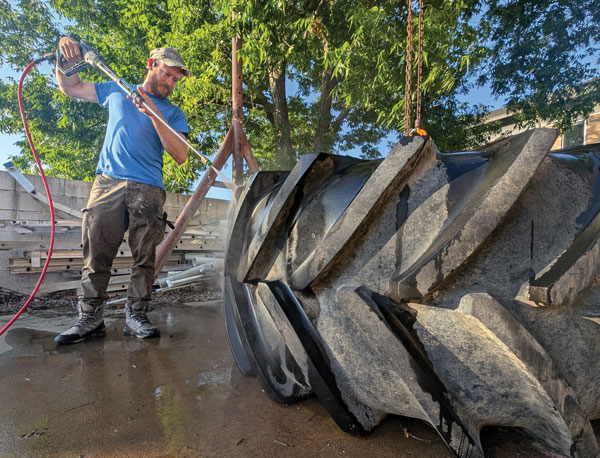
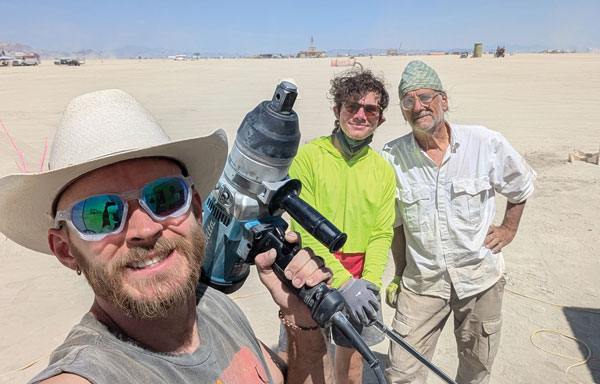
Chris Struble double-majored in computer science and art at Austin College. He is now the Director of Technology at Imperial Dade. His art interest offers balance to his work in technology.
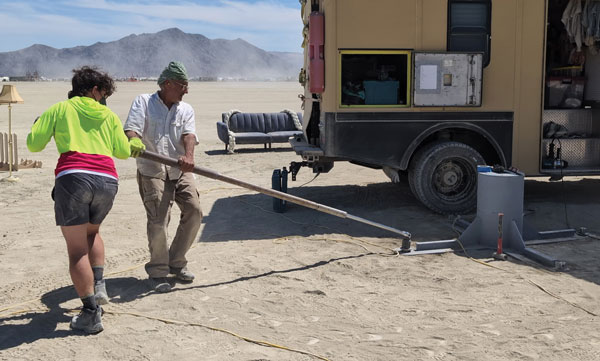
As a creative outlet, Chris, along with Mark Monroe and others, constructed a 30-foot interactive sculpture with a tetherball titled When We Were Young. The sculpture was part of the Burning Man festival in August 2025.
“Pay attention to the edges of your interests and the areas where they overlap. Those overlapping areas are gold mines where creativity can be unleashed in a sustained way and brought into balance.”
— Chris Struble ’12
Courtesy Photos
Madison Taylor ' 22

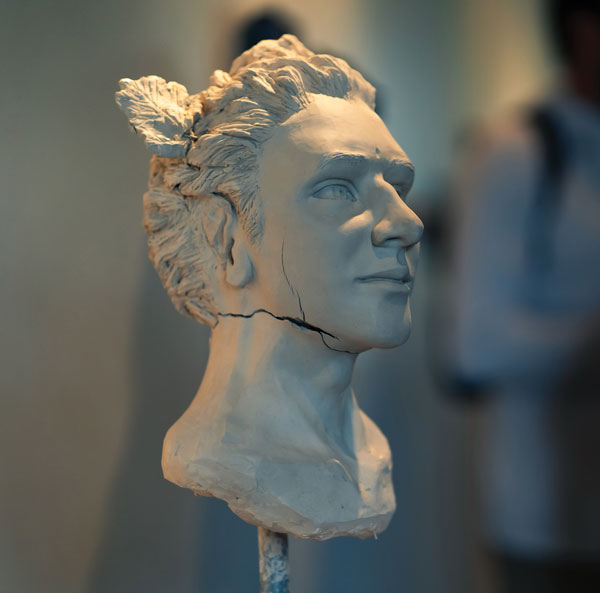
Madison Taylor majored in biology and minored in art at Austin College, and later completed an M.S. in Biomedical Visualization at the University of Illinois Chicago.
Courtesy Photos
“If you stay curious, stay adaptable, and keep building on the things that genuinely excite you, you’ll be able to build a career that’s both meaningful and uniquely your own.”
— Madison Taylor ’22
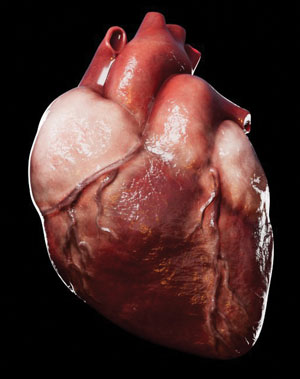
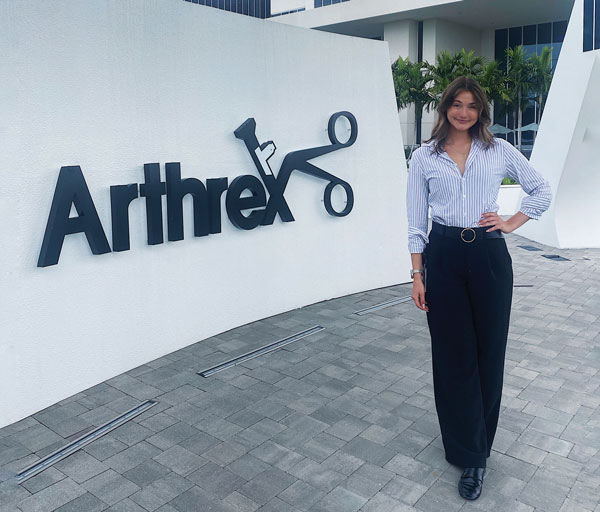
Madison joined the 3D Anatomy team as a 3D Medical Artist at Arthrex, a medical equipment company.
While Madison Taylor ’22 pursued her studies in the sciences, taking pre-med courses and majoring in biology, she also fed her artistic side by minoring in art with no idea where it might lead. “What truly set my liberal arts background apart was the freedom to design my own interdisciplinary path,” said Taylor. “Once I became interested in blending science with art, my professors encouraged me to pursue an independent study where I experimented with digital sculpting using 3D modeling software, learned 3D printing, and even arranged an internship with a prosthetist at Scottish Rite Hospital. By my junior year, I knew I wanted a career that blended both passions.”
Taylor found that blend in the Biomedical Visualization program at the University of Illinois at Chicago. “It has a strong emphasis on technology, particularly 3D modeling and animation,” said Taylor. Beyond anatomical understanding, medical artists also have to be storytellers. Knowing how people learn—what reduces cognitive load, how to sequence information, what to emphasize, what to remove—is essential. This blend of scientific accuracy, clarity, and narrative thinking are key parts of being trained as a medical illustrator. “It felt like the perfect intersection of my classical training in illustration and my growing interest in sculpture and 3D work. It was the first time I saw a career that allowed me to use all parts of myself—scientist, artist, and storyteller.”
Jackie Hatfield ’05
Jackie Hatfield ’05 also found a path that allowed her studies in both art and science to be put to use in her career as Display Technology Specialist at Fortec US. “Display Technology translates into bridging engineering precision with human experience—how a product feels to the user,” she explained. “I approach technical challenges like design challenges: there’s structure, but also intuition. I think the liberal arts mindset helps me balance logic with imagination, so I can move easily between the analytical side of performance specs and the creative side of visual design.”
Hatfield also found her path in the “and” spaces between two disciplines. “My liberal arts education trained me to connect dots between disciplines rather than stay in silos,” said Hatfield. “They [art and physics] ask the same fundamental question, ‘Why does the world look and behave the way it does?’” She found that physics answers that query through laws and structure, while art explores it through perception and emotion. “Studying both fields gave me a kind of dual vision: one analytical and one intuitive. In my physics work, I learned to observe and test ideas methodically; in the studio, I learned to stay open to what happens when control gives way to discovery. Each discipline made the other richer.” For Hatfield, the intersection between disciplines is where real innovation happens.
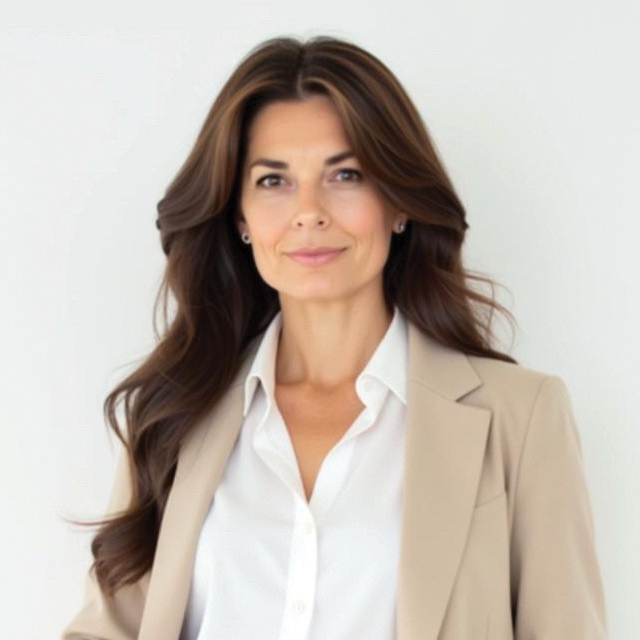
Jackie Hatfield found a path that allowed her studies in both art and science to be put to use in her career as Display Technology Specialist at Fortec US.
“When you’re fluent in more than one way of thinking, you become the person who sees the solutions others miss. Trust that your interests are connected, even if the path doesn’t look linear.”
— Jackie Hatfield ’05